
Sanjay Balachandran / Earth Sustainability Solutions / February 2026
The Union Budget 2026–27, presented by Finance Minister Nirmala Sitharaman in Parliament, signals a decisive shift in India’s development strategy—placing climate action, industrial decarbonisation, and sustainability finance at the centre of economic planning. Rather than positioning environmental protection as a regulatory obligation, the Budget integrates it as a core driver of competitiveness, resilience, and long-term growth.
Carbon Capture & Hard-to-Abate Sectors
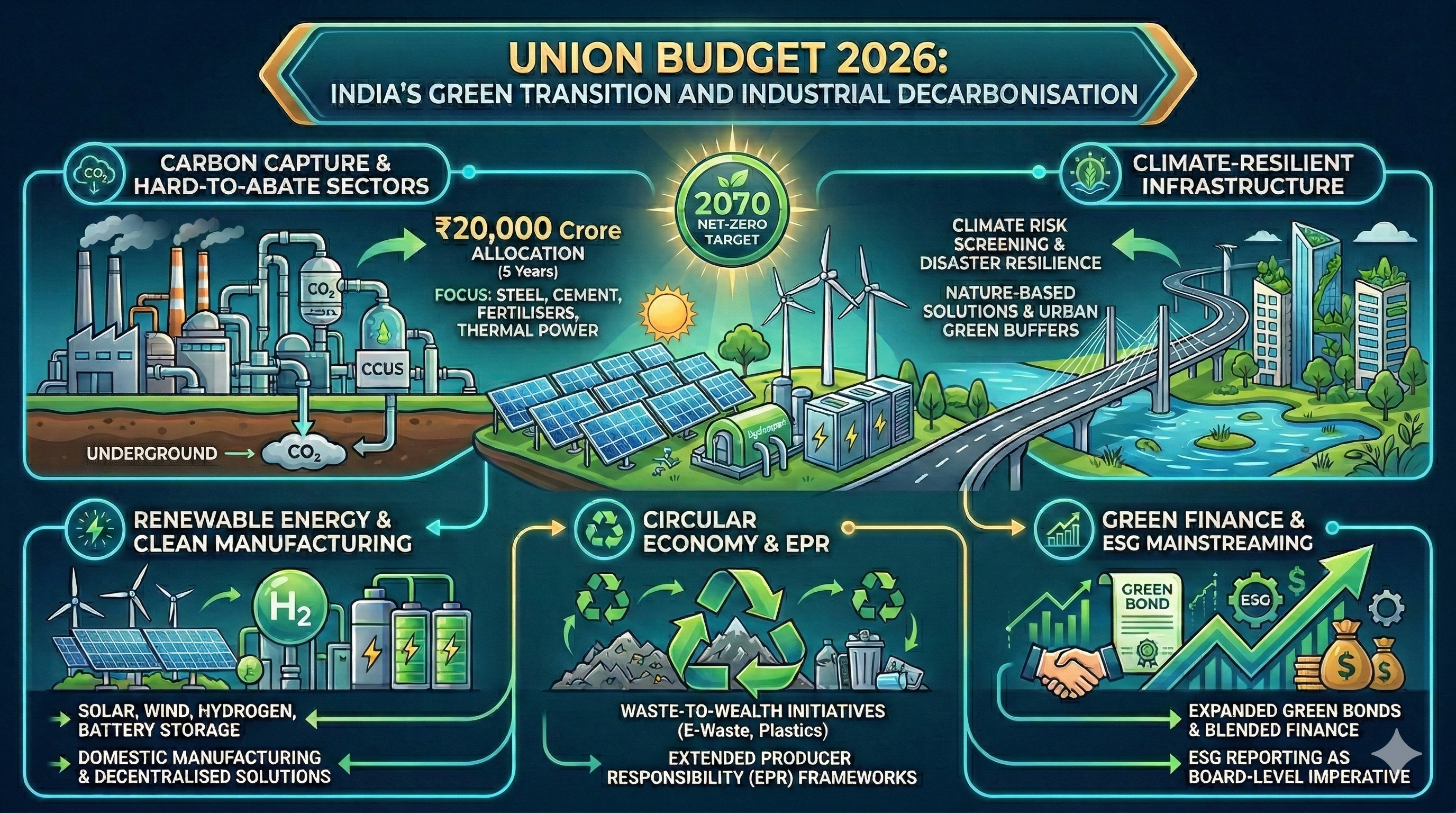
A landmark announcement is the ₹20,000 crore allocation for Carbon Capture, Utilisation and Storage (CCUS) over five years. An initial ₹500 crore has been earmarked for the Ministry of Power to initiate research activities. CCUS is particularly critical for “hard-to-abate” sectors such as steel, cement, fertilisers, refining, and thermal power—industries where deep emission reductions are technically complex and capital-intensive.
India’s CCUS strategy, guided by a roadmap developed under the Department of Science and Technology, prioritises a research-to-deployment pathway. The approach emphasises indigenous technology development, pilot and demonstration projects, integration into existing industrial facilities, and development of shared CO₂ transport and geological storage infrastructure. This signals a strategic intent to safeguard industrial competitiveness while aligning with India’s 2070 net-zero commitment.
For carbon market actors and sustainability advisors, this creates opportunities in emissions quantification, MRV systems (Monitoring, Reporting and Verification), carbon accounting, and technology validation frameworks.
Renewable Energy, Storage & Clean Manufacturing
The Budget reinforces ongoing support for renewable energy expansion—including solar, wind, hybrid systems, green hydrogen, and advanced battery storage. Strengthening domestic clean technology manufacturing and incentivising decentralised energy solutions further accelerates India’s transition to a low-carbon energy architecture.
For industries, this implies greater alignment with lifecycle emissions reduction, Scope 1–3 accounting, and ESG disclosure frameworks. Clean energy integration will increasingly influence capital access, export competitiveness, and compliance positioning.
Climate-Resilient Infrastructure & Natural Capital
Infrastructure planning now embeds climate risk screening, environmental safeguards, and disaster resilience as standard components of project design. Nature-based solutions—such as wetland restoration, urban green buffers, and floodplain management—are being mainstreamed into development frameworks.
The recognition of natural capital as an economic asset underscores the need for biodiversity-sensitive planning, landscape-level environmental assessments, and integration of ecosystem restoration into rural livelihood strategies.
Circular Economy & Compliance Evolution
A stronger policy thrust toward circular economy principles and Extended Producer Responsibility (EPR) frameworks indicates a transition from end-of-pipe compliance to lifecycle sustainability. Waste-to-wealth initiatives covering plastics, e-waste, battery waste, and municipal solid waste demand robust environmental governance and transparent reporting mechanisms.
Green Finance & ESG Mainstreaming
Expansion of green bonds, blended finance instruments, and sustainability-linked financing reflects the increasing convergence between climate policy and capital markets. ESG reporting and environmental governance are no longer peripheral—they are becoming board-level imperatives influencing valuation and investment flows.
Implications for Businesses and Institutions
Union Budget 2026 makes it clear that India’s growth trajectory will be climate-aligned, innovation-driven, and compliance-intensive. For organisations operating in carbon markets, environmental advisory, infrastructure planning, and sustainability finance, this policy environment opens substantial avenues in:
- Carbon accounting and credit development
- Climate adaptation and mitigation planning
- ESG advisory and sustainability reporting
- Biodiversity and ecosystem restoration strategies
- Industrial decarbonisation roadmaps
The message is unequivocal: sustainable growth is no longer optional—it is foundational to India’s economic future.